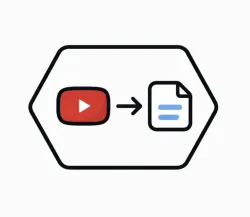
The YouTube Subtitles Transcription API is a powerful tool designed to streamline the process of accessing comprehensive video transcripts from YouTube videos. With this API, users can effortlessly retrieve accurate subtitles in multiple languages, making it easier to understand and share content with a global audience. The API's straightforward integration allows users to use any compatible YouTube URL, reducing the need for complex configurations or data manipulation.
By leveraging this service, content creators, researchers, and businesses can unlock a world of possibilities. Enhancing accessibility, the API empowers users to reach a broader audience, including those with hearing impairments or language barriers. The availability of subtitles in various languages facilitates cross-cultural communication and opens doors to new markets.
The API's versatility extends to public videos with enabled subtitles, eliminating the need for additional permissions or restrictions. Whether it's a viral video, educational content, or a marketing campaign, users can readily retrieve transcripts to support various applications.
The transcripts obtained through the API are highly accurate, preserving the original content's context and essence. This level of precision enables researchers to conduct in-depth content analysis, marketers to fine-tune their strategies, and educators to create engaging lesson plans.
Furthermore, the YouTube Subtitles Transcription API is easy to integrate into existing applications and workflows. With well-documented endpoints and response formats, developers can seamlessly incorporate transcription capabilities into their projects. This saves time and resources while enhancing the overall user experience.
Privacy and security are paramount concerns when dealing with sensitive video content. The API is designed with robust security measures, ensuring that video data and transcripts remain confidential and protected. Users can confidently utilize the API without worrying about potential data breaches.
In conclusion, the YouTube Subtitles Transcription API revolutionizes the way we interact with YouTube videos. Offering hassle-free access to video transcripts in multiple languages, it facilitates communication, enables research, and promotes inclusivity. By empowering developers and users with a comprehensive transcription service, this API opens doors to endless possibilities in the digital age.
Pass the video URL of your choice. Be sure that the video has subtitles enabled, declare the language of the output and receive the translated subtitles.
Video Content Localization: Content creators and businesses can use the YouTube Subtitles Transcription API to automatically generate subtitles in different languages for their YouTube videos. By providing multilingual subtitles, they can reach a broader global audience and expand their viewership, making their content more accessible and engaging to non-native speakers.
Educational Tools: EdTech platforms and online learning portals can integrate the API to offer interactive video lessons with accurate subtitles. This feature aids language learners and students with hearing impairments, enhancing their understanding and retention of educational content.
Market Research and Sentiment Analysis: Market researchers can utilize the API to transcribe and analyze user-generated videos related to their products or services. By understanding the sentiments expressed in the videos, businesses can gain valuable insights into customer feedback and preferences, informing their marketing and product development strategies.
Video SEO and Content Analysis: Digital marketers and SEO professionals can leverage the API to transcribe YouTube videos and analyze the content's keywords and topics. This information can be used to optimize video titles, descriptions, and tags, improving video visibility in search results and driving organic traffic to their channels.
Accessibility Compliance: Websites and applications striving for accessibility compliance can use the API to provide closed captions for YouTube videos embedded on their platforms. Meeting accessibility standards ensures inclusivity, allowing users with disabilities to access and comprehend video content without barriers.
Besides the number of API calls, there is no other limitation
To use this endpoint you need to pass the ID of the video to translate it in json format.availableLangs:
      "zh-CN""zh-Hant""en"
"fr"
"de"
"hi"
"id"
"it"
"ja"
"ko"
"pl"
"pt"
"pa"
"ru"
"es-ES"
"ta"
"th"
"tr"
"vi"
Translate Video - Endpoint Features
| Object | Description |
|---|---|
video_id |
[Required] |
lang |
[Required] |
[{"title":"What the heck is the event loop anyway? | Philip Roberts | JSConf EU","description":"JavaScript programmers like to use words like, “event-loop”, “non-blocking”, “callback”, “asynchronous”, “single-threaded” and “concurrency”.\n\nWe say things like “don’t block the event loop”, “make sure your code runs at 60 frames-per-second”, “well of course, it won’t work, that function is an asynchronous callback!”\n\nIf you’re anything like me, you nod and agree, as if it’s all obvious, even though you don’t actually know what the words mean; and yet, finding good explanations of how JavaScript actually works isn’t all that easy, so let’s learn!\n\nWith some handy visualisations, and fun hacks, let’s get an intuitive understanding of what happens when JavaScript runs.\n\nTranscript: http://2014.jsconf.eu/speakers/philip-roberts-what-the-heck-is-the-event-loop-anyway.html\n\nLicense: For reuse of this video under a more permissive license please get in touch with us. The speakers retain the copyright for their performances.","availableLangs":["zh-CN","zh-Hant","en","fr","de","hi","id","it","ja","ko","pl","pt","pa","ru","es-ES","ta","th","tr","vi"],"lengthInSeconds":"1612","thumbnails":[{"url":"https://i.ytimg.com/vi/8aGhZQkoFbQ/default.jpg?sqp=-oaymwEkCHgQWvKriqkDGvABAfgB_gmAAtAFigIMCAAQARhyIEYoajAP&rs=AOn4CLDvhbqE-A2AXoKiqAd60_F6_re0Jg","width":120,"height":90},{"url":"https://i.ytimg.com/vi/8aGhZQkoFbQ/mqdefault.jpg?sqp=-oaymwEmCMACELQB8quKqQMa8AEB-AH-CYAC0AWKAgwIABABGHIgRihqMA8=&rs=AOn4CLC_7X6ep6qSAGxbGEgrNeDipNDk4g","width":320,"height":180},{"url":"https://i.ytimg.com/vi/8aGhZQkoFbQ/hqdefault.jpg?sqp=-oaymwEmCOADEOgC8quKqQMa8AEB-AH-CYAC0AWKAgwIABABGHIgRihqMA8=&rs=AOn4CLABwixVJ0IvCZ-zf_hBMFALLImy8Q","width":480,"height":360},{"url":"https://i.ytimg.com/vi/8aGhZQkoFbQ/sddefault.jpg?sqp=-oaymwEmCIAFEOAD8quKqQMa8AEB-AH-CYAC0AWKAgwIABABGHIgRihqMA8=&rs=AOn4CLBNf-dCujikR6sOD9rQJLIYZB4FbQ","width":640,"height":480},{"url":"https://i.ytimg.com/vi/8aGhZQkoFbQ/hq720.jpg?sqp=-oaymwE2CK4FEIIDSEbyq4qpAygIARUAAIhCGAFwAcABBvABAfgB_gmAAtAFigIMCAAQARhyIEYoajAP&rs=AOn4CLAPhpOuUwdXcAm3ZNMw90ezPQYKXQ","width":686,"height":386}],"transcription":[{"subtitle":">> (Phillip Roberts) bonjour, venez et asseyez-vous.","start":1.64,"dur":2.88},{"subtitle":"Pour cette dernière session avant la pause\naprès-midi, notre invité est Phillip Roberts qui travaille","start":4.52,"dur":5.78},{"subtitle":"chez &yet et qui est venu de Londres ‑‑ d'Écosse.","start":10.3,"dur":2.52},{"subtitle":"Édimbourg.","start":12.82,"dur":1},{"subtitle":"‑‑ eh ben, ma mémoire ne dure que 10 secondes, il va nous\nparler de l'event loop.","start":13.82,"dur":3.69},{"subtitle":"Pouvez-vous tous donner à Philip\nun tonnerre d'applaudissements.","start":17.51,"dur":1.089},{"subtitle":">> Phillip Roberts : OK, bonjour à tous et merci\nd'avoir ici au side track, c'est génial","start":18.599,"dur":2.34},{"subtitle":"de voir une audience si nombreuse ici.","start":20.939,"dur":1.691},{"subtitle":"Pouvez-vous tous faire un étirement ?","start":22.63,"dur":2.19},{"subtitle":"Je dois m'étirer, pour que j'aie l'air moins étrange.","start":24.82,"dur":6.99},{"subtitle":"Je voudrais parler de l'event loop \net de quoi s'agit l'event loop","start":31.81,"dur":5.409},{"subtitle":"dans JavaScript.","start":37.219,"dur":2.401},{"subtitle":"Donc, comme on vient de le mentionner, je travaille chez &yet\nqui est une petite et fabuleuse boîte de dév","start":39.62,"dur":7.279},{"subtitle":"USA, contactez-nous s'il vous faut de l'aide\npour des trucs en temps réel.","start":46.899,"dur":3.851},{"subtitle":"C'est notre spécialité.","start":50.75,"dur":1.51},{"subtitle":"Donc, il y a 18 mois--Moi, un développeur pro\nrémunéré de JavaScript, je me suis posé cette question","start":52.26,"dur":7.74},{"subtitle":"comment JavaScript fonctionne-t-il en fait ?","start":60,"dur":3.98},{"subtitle":"Et je n'étais pas vraiment sûr.","start":63.98,"dur":1.87},{"subtitle":"J'ai entendu parler du terme V8 , le Runtime de chrome\nMais je ne savais pas ce que ça voulait dire,\nni à quoi ça servait.","start":65.85,"dur":6.87},{"subtitle":"J'ai entendu des choses comme single threaded, vous\nsavez certainement que j'utilise des callbacks","start":72.72,"dur":3.55},{"subtitle":"Comment les callbacks fonctionnent-ils ?","start":76.27,"dur":1.7},{"subtitle":"Je me suis lancé dans un voyage de lecture et de recherche\net j'ai commencé à faire des expériences dans le navigateur","start":77.97,"dur":7.28},{"subtitle":"en commençant comme ça.","start":85.25,"dur":1},{"subtitle":"‑‑ J'ai posé cette question : JavaScript, \nqu'es-tu ?","start":86.25,"dur":4.29},{"subtitle":"Je suis un langage concurrent à thread unique ‑‑\nd'accord.","start":90.54,"dur":5.14},{"subtitle":"ouais, c'est cool, je possède un call stack, un event\nloop, une callback queue, et quelques autres API","start":95.68,"dur":5.38},{"subtitle":"et d'autres trucs.","start":101.06,"dur":1.559},{"subtitle":"‑‑ Je vois.","start":102.619,"dur":1},{"subtitle":"Je n'ai pas obtenu de diplôme en informatique.","start":103.619,"dur":1.64},{"subtitle":"Enfin, ces mots, ça reste des mots, oui j'ai entendu\nparler du V8 et des divers Runtimes et des différents","start":105.259,"dur":6.161},{"subtitle":"navigateurs, j'ai donc interrogé V8, tu as un call\nstack, un event loop, une callback queue, et","start":111.42,"dur":4.45},{"subtitle":"d'autres APIs et trucs, j'ai un call stack\net un heap, je ne connais rien sur les autres","start":115.87,"dur":4.429},{"subtitle":"trucs, d'accord, c'est intéressant, donc en gros\n18 mois se sont écoulés.","start":120.299,"dur":9.38},{"subtitle":"Et je pense avoir compris cela.","start":129.679,"dur":2.871},{"subtitle":"(Rires) et donc, voici ce que je veux\npartager avec vous aujourd'hui.","start":132.55,"dur":3.42},{"subtitle":"J'espère que cela vous sera utile si vous venez récemment\ndécouvrir JavaScript, vous aider à comprendre pourquoi","start":135.97,"dur":5.54},{"subtitle":"JavaScript est si étrange lorsqu'on le compare\nà d'autres langages que vous avez peut-être utilisés, pourquoi les","start":141.51,"dur":4.55},{"subtitle":"callbacks sont quelque chose d'important qui nous donne des cauchemars\nmais dont on ne peut pas se passer.","start":146.06,"dur":3.23},{"subtitle":"Et si vous êtes un JavaScript chevronné\nj'espère vous offrir quelques nouvelles informations","start":149.29,"dur":6.25},{"subtitle":"sur le fonctionnement du Runtime que vous utilisez\npour vous permettre d'y songer un peu mieux.","start":155.54,"dur":5.35},{"subtitle":"Donc si nous jetons un coup d'œil sur le JavaScript Runtime\nlui-même comme V8, le Runtime de Chrome.","start":160.89,"dur":10.49},{"subtitle":"Voici une vue simplifiée du\nJavaScript Runtime.","start":171.38,"dur":3.749},{"subtitle":"Le heap (tas), où a lieu l'allocation mémoire,\net ensuite le call stack (pile d'exécution), où","start":175.129,"dur":6.72},{"subtitle":"se trouvent vos stack frames (blocs de pile) et tout\nce genre de choses, mais, si par exemple, vous clonez le code base et le grep","start":181.849,"dur":8.081},{"subtitle":"du V8 pour des trucs comme setTimeout\nune requête DOM ou HTTP, vous ne les trouverez pas,","start":189.93,"dur":7.79},{"subtitle":"elles n'existent pas V8, chose qui\nm'a surpris.","start":197.72,"dur":3.66},{"subtitle":"C'est la première chose que vous utilisez lorsque vous pensez\naux trucs async et pourtant, elle est absente du code source du V8.","start":201.38,"dur":6.55},{"subtitle":"Hum… intéressant.","start":207.93,"dur":1.46},{"subtitle":"Donc, au cours de ces 18 mois de découvertes, j'ai\nfini par comprendre que c'est vraiment, c'est vraiment","start":209.39,"dur":6.47},{"subtitle":"la vue d'ensemble, c'est ce que j'espère\nvous aider à suivre aujourd'hui et comprendre","start":215.86,"dur":4.189},{"subtitle":"ce que sont ces pièces, nous avons le V8 Runtime\nmais aussi ces trucs qu'on appelle web API","start":220.049,"dur":5.05},{"subtitle":"qui sont des suppléments fournis par le navigateur.","start":225.099,"dur":2.811},{"subtitle":"DOM, AJAX, setTimeout, des trucs comme ça, nous\navons aussi ce mythique event loop et la","start":227.91,"dur":6.95},{"subtitle":"callback queue.","start":234.86,"dur":1},{"subtitle":"Je suis certain que vous avez entendu quelques-uns de ces termes\nauparavant, sans bien comprendre de quoi il s'agissait.","start":235.86,"dur":3.57},{"subtitle":"comment ces pièces agissent ensemble.","start":239.43,"dur":2.44},{"subtitle":"Donc, je vais commencer dès le début,\ncertaines choses pourraient être nouvelles pour vous, les mots évoqués","start":241.87,"dur":4.759},{"subtitle":"pourraient être nouveaux pour vous, quelques-uns les reconnaîtront.","start":246.629,"dur":2.261},{"subtitle":"Nous allons enchaîner rapidement à partir de là,\nsoyez indulgents si c'est évident, je pense que ce n'est pas","start":248.89,"dur":5.05},{"subtitle":"le cas pour de nombreuses personnes.","start":253.94,"dur":2.24},{"subtitle":"Donc, JavaScript est un langage de programmation à\nthread unique dont le Runtime est à thread unique, il dispose","start":256.18,"dur":5.11},{"subtitle":"d'un seul call stack.","start":261.29,"dur":2.1},{"subtitle":"Et il peut faire une seule chose à la fois,\nc'est ce que signifie thread unique, le programme peut","start":263.39,"dur":5.18},{"subtitle":"exécuter un seul morceau de code à la fois.","start":268.57,"dur":2.35},{"subtitle":"Donc, essayons de visualiser cela pour\nnous faire idée de ce que cela veut dire,\ndonc si j'ai","start":270.92,"dur":4.47}]},{"_note":"Response truncated for documentation purposes"}]
curl --location --request GET 'https://zylalabs.com/api/2257/youtube+subtitles+transcription+api/7459/translate+video?video_id=Required&lang=Required' --header 'Authorization: Bearer YOUR_API_KEY'
| Header | Description |
|---|---|
Authorization
|
[Required] Should be Bearer access_key. See "Your API Access Key" above when you are subscribed. |
No long-term commitment. Upgrade, downgrade, or cancel anytime. Free Trial includes up to 50 requests.
Yes, the API can handle videos with multiple subtitle tracks. It provides an option to specify the desired subtitle language or retrieve transcripts for all available languages, ensuring flexibility in handling diverse content.
Yes, to prevent abuse, the API implements rate-limiting. The specific rate limits and quotas are detailed in the API documentation. Developers should adhere to these limits to maintain a smooth and efficient service.
No, the API currently works only with public YouTube videos that have subtitles enabled. For private videos or videos without subtitles, alternative solutions or manual transcription may be required.
The API strives to provide accurate transcripts, but the accuracy may vary based on the quality of the original subtitles. It is recommended to review the generated transcripts and perform any necessary post-processing or corrections based on specific use cases.
As of the current version, the API does not support real-time transcription for live streams. It focuses on retrieving transcripts from pre-recorded videos available on YouTube.
The Translate Video endpoint returns a JSON object containing the video title, description, and a transcript of the subtitles in the specified language. This allows users to access key information about the video along with its translated content.
The key fields in the response data include "title," "description," and "transcript." Each field provides essential information about the video and its subtitles, enabling users to understand the content contextually.
The returned data is structured in JSON format, consisting of an array of objects. Each object contains fields like "title," "description," and "transcript," making it easy to parse and utilize in applications.
The Translate Video endpoint accepts parameters such as the video ID and the desired output language. Users can specify the language code (e.g., "en" for English, "fr" for French) to customize their data requests.
The response data is organized as an array of objects, where each object represents a video. Within each object, fields like "title," "description," and "transcript" are clearly defined, allowing for straightforward access to the information.
The data is sourced directly from YouTube's public videos that have subtitles enabled. This ensures that the transcripts reflect the original content accurately, as they are derived from the captions provided by video creators.
Data accuracy is maintained by retrieving subtitles directly from YouTube, which are typically generated by content creators. However, users are encouraged to review transcripts for context and clarity, as accuracy may vary based on subtitle quality.
Typical use cases include video content localization, educational tools for language learners, market research through sentiment analysis, and enhancing accessibility compliance for users with disabilities.
Please have a look at our Refund Policy: https://zylalabs.com/terms#refund
To obtain your API key, you first need to sign in to your account and subscribe to the API you want to use. Once subscribed, go to your Profile, open the Subscription section, and select the specific API. Your API key will be available there and can be used to authenticate your requests.
You can’t switch APIs during the free trial. If you subscribe to a different API, your trial will end and the new subscription will start as a paid plan.
If you don’t cancel before the 7th day, your free trial will end automatically and your subscription will switch to a paid plan under the same plan you originally subscribed to, meaning you will be charged and gain access to the API calls included in that plan.
The free trial ends when you reach 50 API requests or after 7 days, whichever comes first.
No, the free trial is available only once, so we recommend using it on the API that interests you the most. Most of our APIs offer a free trial, but some may not include this option.
Yes, we offer a 7-day free trial that allows you to make up to 50 API calls at no cost, so you can test our APIs without any commitment.
Zyla API Hub is like a big store for APIs, where you can find thousands of them all in one place. We also offer dedicated support and real-time monitoring of all APIs. Once you sign up, you can pick and choose which APIs you want to use. Just remember, each API needs its own subscription. But if you subscribe to multiple ones, you'll use the same key for all of them, making things easier for you.
Service Level:
100%
Response Time:
3,326ms
Service Level:
100%
Response Time:
699ms
Service Level:
100%
Response Time:
4,822ms
Service Level:
100%
Response Time:
1,099ms
Service Level:
100%
Response Time:
2,985ms
Service Level:
100%
Response Time:
1,827ms
Service Level:
100%
Response Time:
1,360ms
Service Level:
100%
Response Time:
4,742ms
Service Level:
100%
Response Time:
88ms
Service Level:
100%
Response Time:
657ms